How to Learn Languages with Audiobooks: The 0.75x Trick
Key Takeaways
- The Brain Gap: Humans speak at ~150 wpm but think at ~400 wpm. This gap causes distractions.
- The Sweet Spot: Comprehension remains high up to 275 wpm (approx 1.75x speed).
- Silence Removal: Using "Smart Speed" apps is more effective than raw speed increases.
- The Rule: Speed up information (Non-fiction), slow down experience (Fiction).
Table of Contents
The biggest lie in language learning is that you need to "listen like a native" from Day 1.
If you are learning Spanish, and you try to listen to a native speaker at full speed, you will hear a wall of noise. You won't hear "¿Cómo estás?". You will hear "Comestas".
Your brain cannot parse the phonemes fast enough. It is not a vocabulary problem; it is a processing speed problem.
Most people give up here. They go back to Duolingo. They think they are "bad at languages."
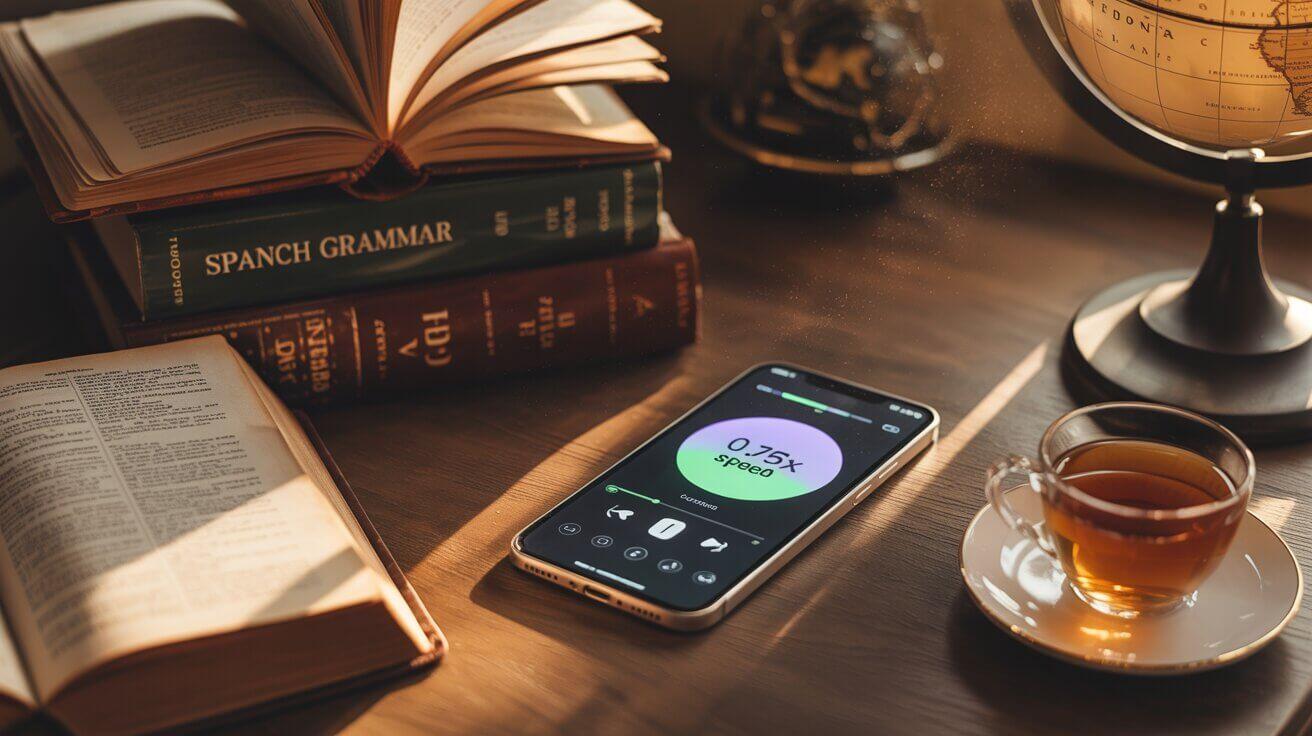
But there is a cheat code. The same tool we use to speed-read business books and get through lectures faster can be used in reverse to decode foreign languages. The secret weapon of the hyper-polyglot is 0.75x Speed.
Here is the complete protocol for using Variable Speed Playback (VSP) to master a new language in record time.
The Science: Decoding "Connected Speech"
Why do natives sound so fast? It's not just speed. It's a phenomenon linguists call Connected Speech.
In textbooks, words are separate islands. In reality, words blend together.
- Elision: Leaving out sounds (e.g., "Next day" becomes "Nexday").
- Assimilation: Sounds changing to match neighbors (e.g., "Ten bucks" becomes "Tembucks").
- Liaison (French): The end of one word attaches to the start of the next.
Natives speak at roughly 150-180 words per minute. But a beginner's brain can only process about 90-110 wpm. When Connected Speech happens at 150 wpm, your brain's "parser" crashes.
The 0.75x Solution: By dropping the speed to approx 110-135 wpm, you don't just slow down the time; you stretch the transitions. You artificially separate the islands.
The "Narrow Listening" Protocol (Variable Speed Repetition)
Listening to a whole chapter once is less effective than listening to one minute fifty times. This is the principle of Narrow Listening, rooted in Stephen Krashen's comprehensible input research.
But listening at the same speed is boring. Here is the "Speed Ramp" drill to force your ear to adapt:
The Speed Ramp Drill (10 Minutes)
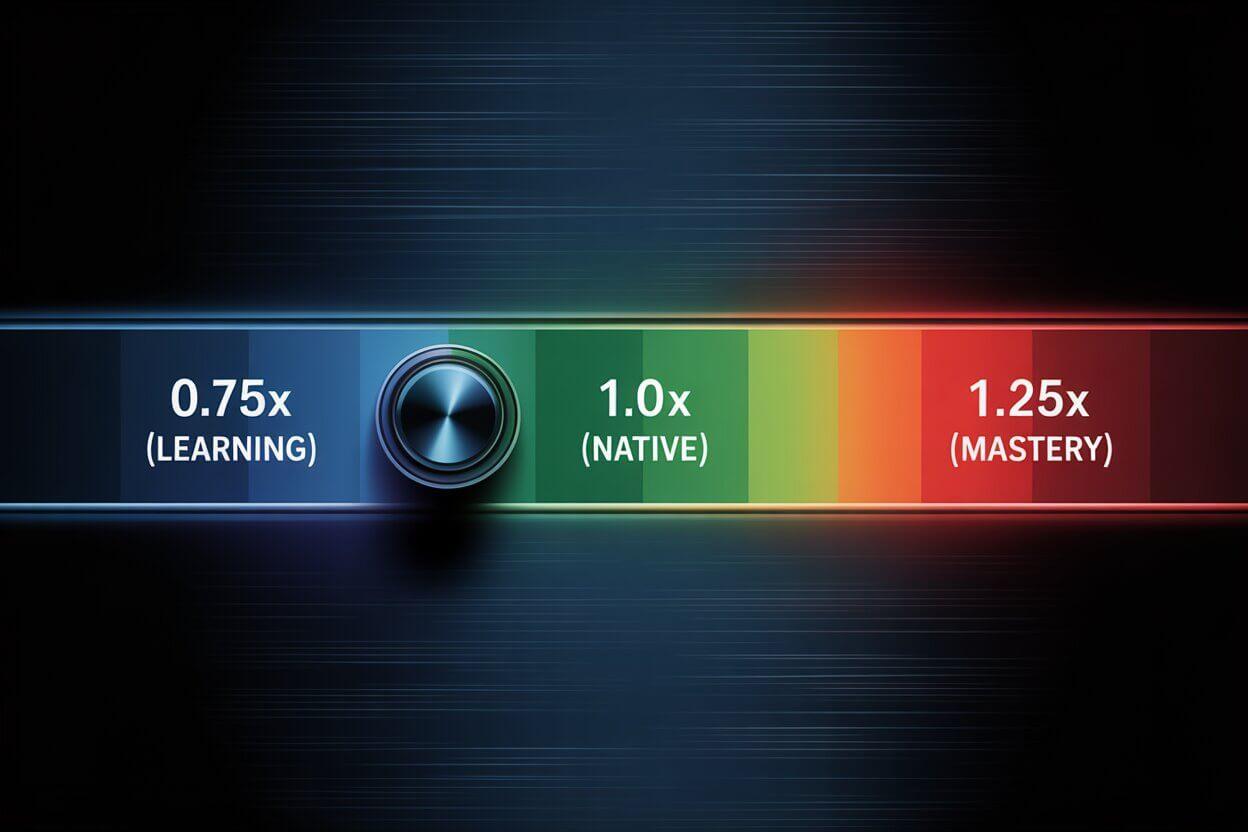
- Reps 1-3 (0.75x): Listen for individual sounds. Identify words you know.
- Reps 4-6 (0.9x): Listen for the rhythm. Try to tap your foot to the cadence.
- Reps 7-9 (1.0x): Native speed. Just let it wash over you.
- Reps 10-12 (1.25x): Over-speed. This will feel chaotic.
- Final Rep (1.0x): Return to normal. It will suddenly feel slow and incredibly clear.
By pushing your brain past the limit (1.25x), you reset your baseline. When you return to 1.0x, the "Connected Speech" no longer sounds fast.
The "Input Stacking" Method (L-R Method)
Listening alone is hard. Reading alone is dangerous (you invent the wrong pronunciation).
The most powerful way to use 0.75x speed is by Input Stacking (also known as the Listening-Reading Method).
Why it works: Your eyes see the separate words. Your ears hear the connected speech (slowed down). Your brain bridges the gap.
If you do this for 1 hour a day, you will learn more vocabulary in a month than in 2 years of high school classes. The 0.75x speed is crucial because it gives your eyes enough time to track the text without getting lost.
The "Shadowing" Technique (Active Training)
Passive listening is weak. To truly learn, you need to use the Shadowing Technique, popularized by polyglot Prof. Alexander Arguelles.
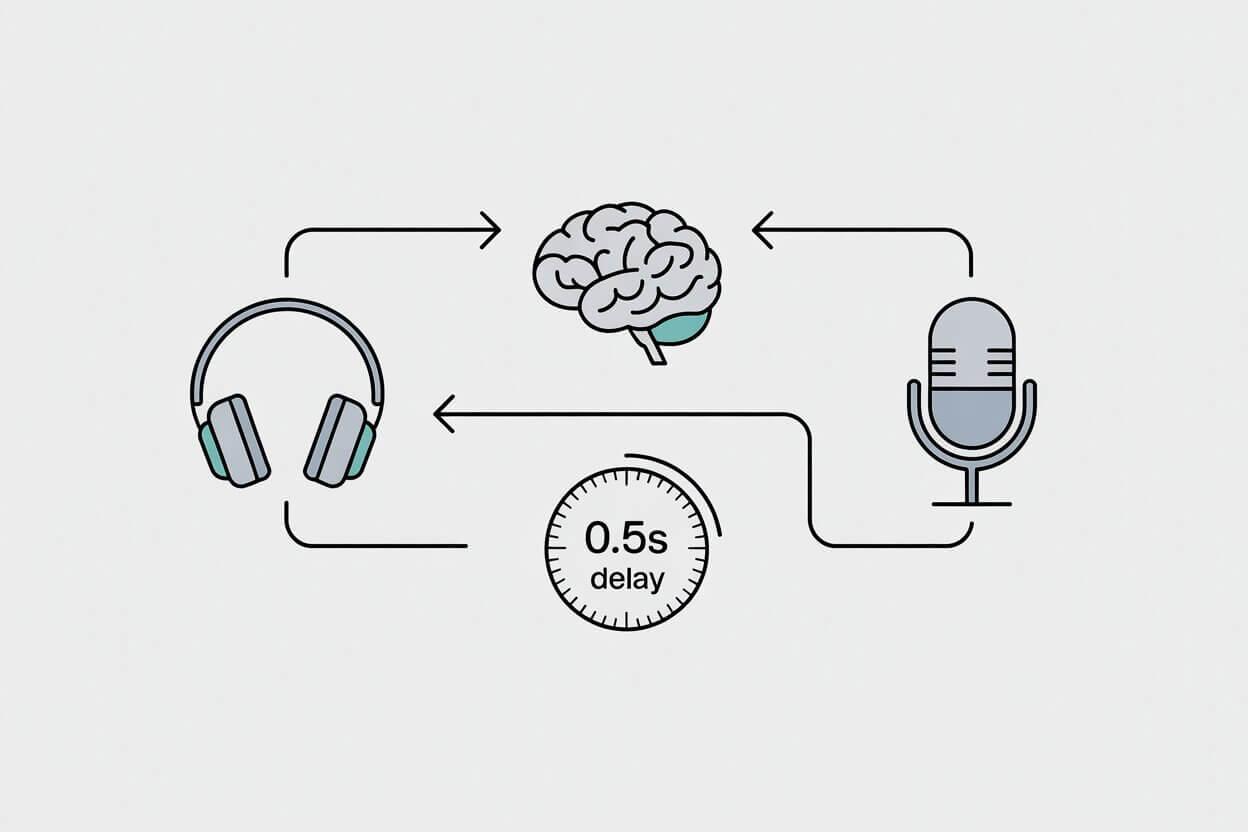
The Method: You speak the words simultaneously with the recording, just a split-second behind the narrator. Like a shadow.
Doing this at 1.0x is impossible for beginners. You will stumble over your own tongue. But at 0.75x, it creates a "training wheels" effect.
The 3-Step Shadowing Protocol
- Step 1 (Blind Shadowing - 0.75x): Play the audio slow. Do NOT look at the text. Try to mimic the sounds exactly. Focus on the melody and rhythm.
- Step 2 (Text Shadowing - 0.75x): Open the transcript/book. Shadow again while reading. Connect the sound to the spelling.
- Step 3 (Speed Up - 1.0x): Once your mouth knows the dance, speed it up to normal. Shadow again. Now focus on intonation.
How I ran this on Spanish (a worked example)
Book: El Principito (Spanish edition) · My level at the time: A2→B1
- Passive listen at 0.75x of the whole chapter — ~12 min. Just tuning the ear to the connected speech.
- Sentence-by-sentence shadowing at 0.9x — ~20 min. This is the real work.
- Re-listen at 1.0x with no text to check comprehension — ~8 min.
Result after ~3 weeks of doing this daily: I could follow that chapter at full native speed with no subtitles. The 0.75x → 0.9x → 1.0x ramp is what made the jump feel gradual instead of impossible.
The "Micro-Looping" Method
Sometimes, a whole chapter is too much. Sometimes, there is just one sentence that tangles your tongue.
For this, you need a player that supports A-B Looping (like Podcast Addict or WorkAudioBook).
- Find a complex sentence (e.g., a French sentence with 3 liaisons).
- Set Point A at the start and Point B at the end.
- Set Speed to 0.5x.
- Loop it 20 times.
At 0.5x, you will hear the subtle tongue movements. Your mirror neurons will fire. After 20 loops, slowly bump it to 0.6x, then 0.7x. This is how musicians learn difficult solos. It works for languages too.
Audio Hygiene: EQ Settings for Language
We talked about headphones for speed listening, but for language learning, the requirements are different.
Different languages occupy different frequency ranges. If you can't hear the difference between "Dessert" and "Désert", your Equalizer (EQ) might be to blame.
- For French/Portuguese (Nasal Sounds): These vowels live in the lower mids (200Hz - 500Hz). Do NOT cut the bass too much, or the nasals will disappear.
- For Spanish/Italian (Machine Gun): The information is in the consonants (2kHz - 4kHz). Boost the Treble slightly to hear the separation between words.
- For Mandarin/Thai (Tonal): Pitch is everything. Use "Flat" EQ. Do not boost bass or treble, as it distorts the fundamental pitch contour essential for meaning.
Strategies by Language Family
Not all languages react to speed changes in the same way. Here is how to adapt your settings based on what you are learning.
Romance (Spanish, Italian)
The Problem: The "Machine Gun" effect. Syllables are spoken incredibly fast and evenly.
The Fix: 0.75x is essential to hear where one word ends and the next begins. Focus on vowel clarity.
French
The Problem: Liaisons and Silent Letters. "Ils ont" sounds like "Ilzon".
The Fix: 0.8x. You need to hear the subtle "Z" or "T" sounds that bridge words. Pitch correction is vital here.
Asian (Mandarin, Thai)
The Problem: Tones. Ma, Má, Mǎ, Mà.
The Fix: 0.75x is risky if the player distorts pitch. Ensure you use a high-quality player (Audible/VLC) that preserves pitch. Use Micro-Looping to mimic the pitch contour exactly.
German / Slavic
The Problem: Consonant Clusters. "Schlittschuh".
The Fix: 0.6x. You need extreme slowness to hear all the consonants stacked together.
Best Content for Speed Training
Do not use "Learner Content" (like textbook CDs). They are already slow and unnatural. They teach you "fake" language.
Use Native Content meant for native speakers, and slow it down yourself.
- Non-Fiction Audiobooks: The vocabulary is formal and clear. Narrators articulate well. Recommendation: one of these beginner-friendly non-fiction titles like "Sapiens" or "Atomic Habits" in your target language. You probably already know the ideas, so you can focus on the words.
- News Podcasts: News anchors speak in "Standard" dialect. Recommendation: "News in Slow French" is great, but taking "Le Monde" daily news and playing it at 0.75x is cheaper and more authentic.
The Best Apps for Language Slow-Down
Not all players handle slow speeds well. Some make the voice sound like a demonic robot (pitch distortion). You need players with "Time Stretching" algorithms.
- Audible: Surprisingly good. 0.7x and 0.8x settings preserve pitch perfectly.
- YouTube: Excellent. Use "Custom Speed" to dial in 0.85x if 0.75x is too slow.
- Podcast Addict (Android): The king. Allows silence skipping and slow speeds simultaneously.
- WorkAudioBook (App): Designed specifically for this. It automatically pauses after every sentence to let you repeat. Highly recommended for Micro-Looping.
The "Interleaving" Strategy
If you only listen at 0.75x, you will eventually get bored. If you only listen at 1.0x, you will get frustrated.
Interleaving is the practice of mixing difficulties to keep the brain engaged.
Create a playlist that alternates:
- 5 Minutes: Hard News (0.75x) - High Focus.
- 5 Minutes: Easy Music (1.0x) - Relaxation.
- 5 Minutes: Audiobook (0.9x) - Story Flow.
This variation prevents "Auditory Fatigue" and allows you to study for 2 hours instead of 20 minutes.
The 1-Hour Polyglot Routine
How do you fit this into your day? Here is a high-intensity study block that uses speed modulation.
| Time | Activity | Speed Setting |
|---|---|---|
| 00-15m | Passive Listening (Warm up) | 1.0x |
| 15-35m | Input Stacking (Reading + Listening) | 0.75x |
| 35-50m | Micro-Looping difficult sentences | 0.5x - 0.6x |
| 50-60m | Review / Playback | 1.0x |
Troubleshooting: Why do I still not understand?
You slowed it down to 0.75x. You are focused. But you still don't understand the sentence.
This is a critical diagnostic moment.
- Scenario A: You hear the word clearly, but you don't know what it means.
Diagnosis: Vocabulary Gap. Slowing down won't help. Pause and look it up. - Scenario B: You know all the words when you read them, but you didn't catch them in the audio.
Diagnosis: Parsing Gap. This is where 0.75x shines. Repeat the section until your ear "maps" the sound to the word.
The "Over-Speed" Immersion Hack (1.5x)
Once you are at an Intermediate level (B1/B2), you should actually flip the script. Start listening to podcasts at 1.25x or 1.5x.
Why? It's called "Overloading".
Think of baseball players swinging with a heavy bat before stepping up to the plate.
If you train your ears to catch Spanish at 1.5x, real-life Spanish speakers (who are notoriously fast) will seem slow and articulate. You will stop saying "Can you repeat that?" and start saying "Si, claro."
Polyglot FAQ
Can I learn while sleeping?
No. Passive listening (background noise) is weak. Speed training requires active focus. You are better off doing 15 minutes of 0.75x Shadowing than 8 hours of sleep-listening.
Will I develop a slow accent?
Only if you never speed up. That is why Step 3 of the Shadowing Protocol (Returning to 1.0x) is non-negotiable. You use 0.75x to learn the mechanics, and 1.0x to learn the flow.
Conclusion: Control Time, Control Fluency
The playback speed slider is not just for efficiency. It is a difficulty slider for reality.
When you are a beginner, lower the difficulty to 0.75x to survive. When you are advanced, raise it to 1.5x to thrive.
Stop letting the narrator dictate the pace of your learning. Take control.
Calculate your learning schedule:
Open the audiobook calculatorRelated Articles
How to Listen to Lectures at 2.0x (And Actually Pass)
University lectures are too slow. Here is the 'Search & Destroy' protocol using Video Speed Controller, Flow-Based Notes, and AI tools to save 90 hours a semester.
The 7 Best Audiobooks to Start Speed Listening (2026)
Not all audiobooks are created equal. These 7 best-sellers have slow narrators and clear structures, making them perfect for training your ears at 1.75x speed.
The Audiobook Speed Cheat Sheet: How Long Will It Take? (Charts)
Quick reference tables for 1.25x, 1.5x, and 2.0x speeds. See exactly how much time you save on 8h, 10h, and 12h audiobooks.