The 1.25x vs 1.5x Showdown: Which Speed is Best for You?
Key Takeaways
- The Brain Gap: Humans speak at ~150 wpm but think at ~400 wpm. This gap causes distractions.
- The Sweet Spot: Comprehension remains high up to 275 wpm (approx 1.75x speed).
- Silence Removal: Using "Smart Speed" apps is more effective than raw speed increases.
- The Rule: Speed up information (Non-fiction), slow down experience (Fiction).
Table of Contents
There is a war going on in the settings menu of your audiobook app.
On one side, you have the Purists. They listen at 1.0x. They believe that touching the speed dial is a crime against art. We are not talking to them today.
On the other side, you have the Speed Demons (like me). We listen at 1.75x or 2.0x. We treat information like a firehose.
But in the middle lies the vast majority of listeners. You are the ones who know 1.0x is too slow, but you are terrified that 2.0x will ruin the experience. You are stuck in the "Comfort Zone Dilemma".
The question I get asked most often via email is precise: "Mehdi, is the jump from 1.25x to 1.5x really worth it?"
Does that extra 0.25x actually save significant time, or does it just make the narrator sound caffeinated?
Today, we settle the debate. We will look at the math, the neuroscience of pitch, and the specific use cases for each speed. Let's crunch the numbers.
The Raw Math: What is 0.25x Worth?
Human beings are bad at exponential math. We intuitively think that going from 1.25x to 1.5x is a small change. It looks like a small step on the slider.
But time savings are not linear. Let's look at the data for a standard 10-hour Audiobook (like Atomic Habits or Greenlights).
| Speed | Listening Time | Time Saved vs 1.0x | The "Gain" |
|---|---|---|---|
| 1.0x | 10 hours | 0 mins | - |
| 1.25x | 8 hours | 2 hours | Base Improvement |
| 1.50x | 6 hours 40 mins | 3 hours 20 mins | +1h 20m vs 1.25x |
The Verdict: On a single book, switching from 1.25x to 1.5x saves you an additional 1 hour and 20 minutes.
That is an entire gym session. That is a movie. That is a long walk with your dog. Just by moving the slider a few millimeters.
The "Yearly Compound" Effect
Small numbers deceive us. Let's scale this up. Suppose you are a dedicated listener who consumes 20 books a year (roughly 200 hours of raw audio).
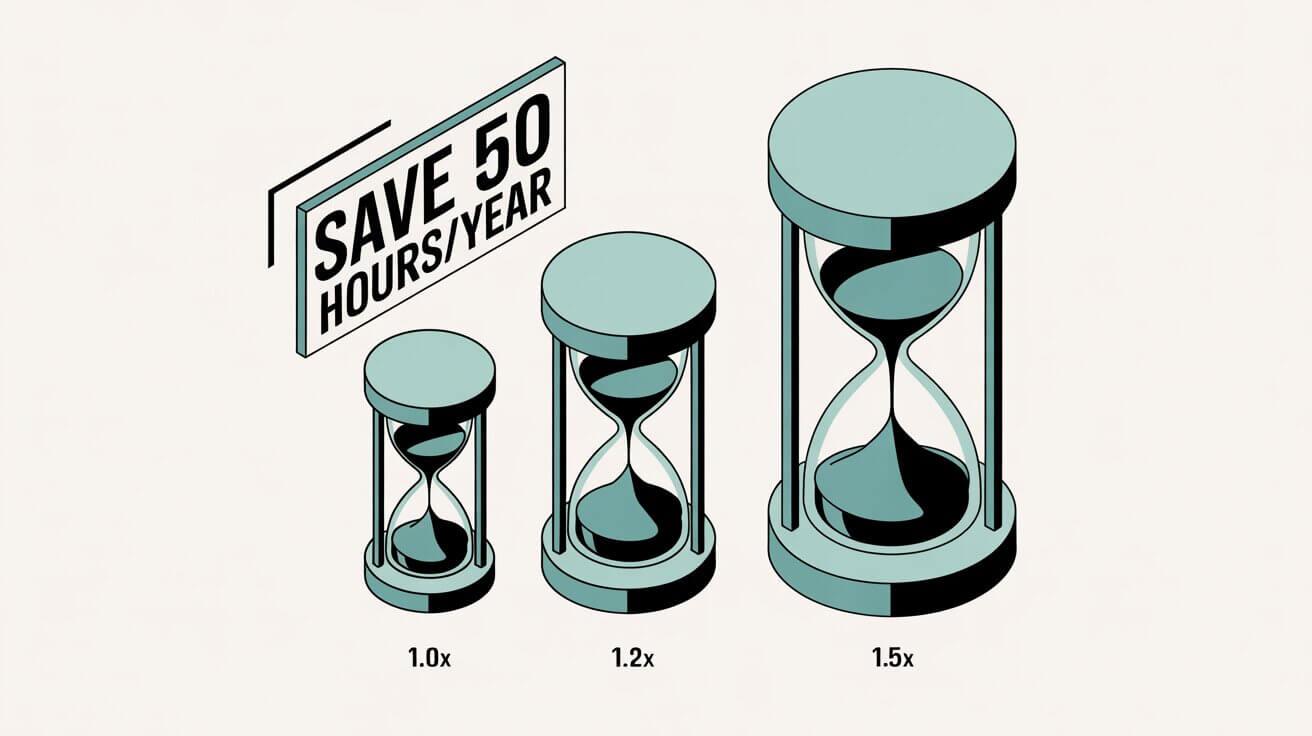
- At 1.25x, you spend 160 hours listening. You save 40 hours.
- At 1.50x, you spend 133 hours listening. You save 67 hours.
The difference between the two speeds over a year is 27 hours.
That is more than a full day and night of your life. If you choose 1.25x because it feels "slightly more comfortable," you are paying 27 hours of your life for that comfort. Is it worth it?
The "Uncanny Valley" of Narrators
If the math is so clear, why does 1.5x feel so fast to beginners?
It comes down to Phonemic Restoration and the "Uncanny Valley" of sound.
1.25x is the "Safety Speed".
At 1.25x, the pauses between sentences are shortened, but the length of the vowels (A, E, I, O, U) remains largely natural. Your brain perceives this not as "fast playback," but as "an energetic speaker." It sounds like the narrator just had a cup of coffee. It requires almost zero additional cognitive load.
1.5x is the "Efficiency Speed".
At 1.5x, we cross a biological threshold. The breathing pauses disappear almost entirely. The vowels are compressed.
The Science of Distortion (Why it sounds weird)
When you speed up audio digitally, the software uses an algorithm called SOLA (Synchronized Overlap-Add). It cuts the audio into tiny grains and deletes some of them to shorten the time, while keeping the pitch the same.
At 1.25x, SOLA is invisible. The grains are large enough that the brain smooths them over.
At 1.5x, however, we start to see "micro-artifacts".
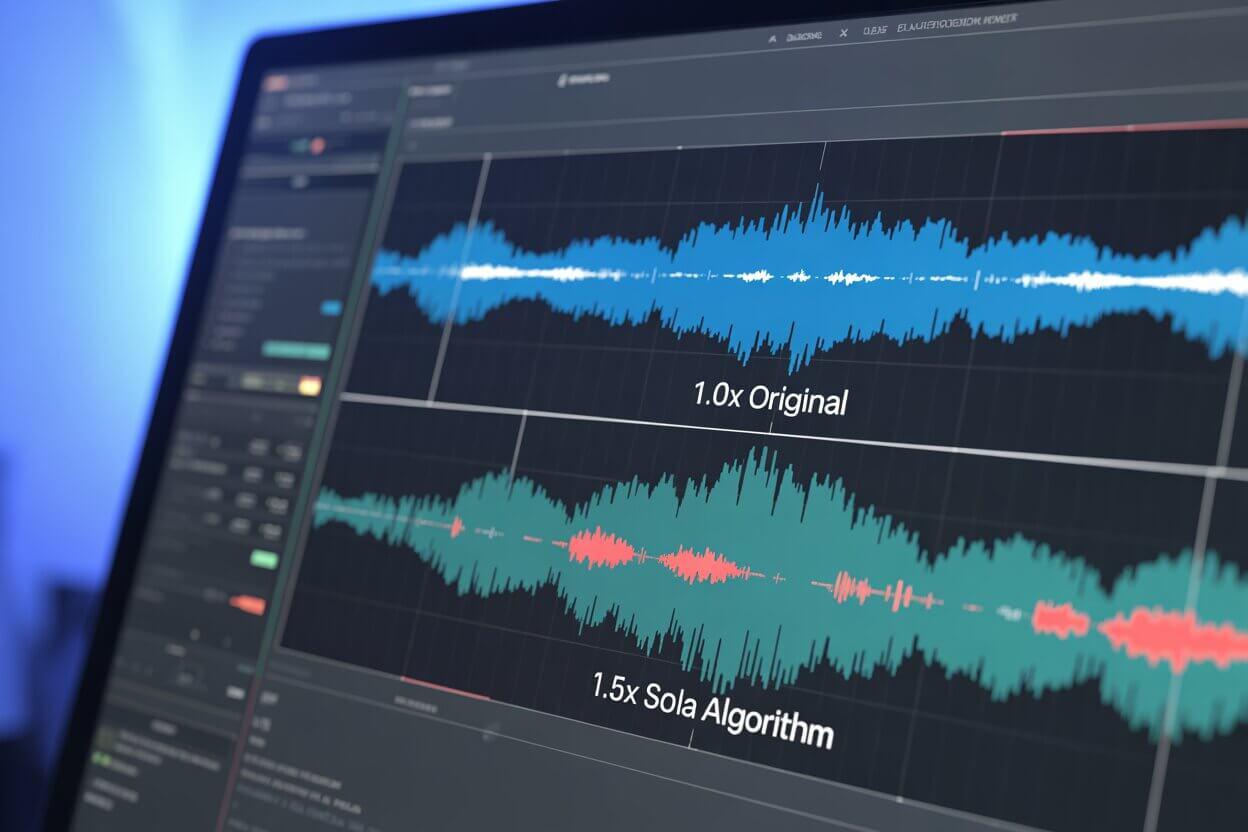
This is why 1.5x can sound "robotic" or "metallic" on cheap headphones. The compression eats the warmth of the voice.
The Fix: If 1.5x sounds bad to you, it might not be the speed. It might be the EQ. Try boosting your "Low Mids" (250Hz - 500Hz) by +2dB. This restores the warmth that the SOLA algorithm stripped away.
The "Narrator Factor": Why Speed is Relative
This is the variable that breaks all the rules. Not all narrators are created equal. You cannot set a "Default Speed" for every book because narrators have different baseline cadences.
Here is my classification of Narrator Types and the recommended speed for each.
Type A: The "Performer" (Fiction/Memoir)
Examples: Stephen Fry (Harry Potter), Matthew McConaughey (Greenlights).
These narrators act. They use dramatic pauses. They whisper. They shout.
- Recommended Speed: 1.25x.
- Why? If you go to 1.5x, you crush the dramatic timing. The emotional impact of the pause is lost. For these books, 1.25x tightens the pacing without killing the soul of the performance.
Type B: The "Lecturer" (Non-Fiction/Business)
Examples: Malcolm Gladwell, James Clear, Yuval Noah Harari.
These narrators are conveying information. Their goal is clarity, not emotion. They tend to articulate perfectly and speak slowly to ensure understanding.
- Recommended Speed: 1.5x to 1.75x.
- Why? Their articulation is so perfect that it can withstand heavy compression. Even at 1.75x, every syllable is crisp. Listening to them at 1.25x often feels agonizingly slow because your brain is waiting for the next concept.
Type C: The "Drone" (Textbook/Old Classics)
Examples: Older recordings of Philosophy, Public Domain readings.
These are often recorded with flat affect and very slow pacing (under 130 wpm).
- Recommended Speed: 2.0x+.
- Why? You need to speed them up just to reach a normal conversational baseline.
The Science: What is the Limit?
Is 1.5x too fast for learning? Science says no.
A landmark study by Foulke & Sticht (1969) tested blind students (who rely on audio) on comprehension at various speeds.
- At 175 wpm (~1.25x): Comprehension was 100%.
- At 275 wpm (~1.75x): Comprehension remained at 95%.
- At 300 wpm (~2.0x): Comprehension dropped slightly to 80%.
This means that 1.5x (approx 225 wpm) is well within the "Safe Zone" of human processing. Your brain is not missing data. It is simply processing it faster. The feeling of "this is too fast" is emotional, not cognitive. If the retention question still nags at you, I unpack it fully in is speed listening cheating?
The "Commute Strategy"
Instead of picking a speed based on the book, try picking a speed based on your available time. This is a strategy I use to finish chapters before I arrive at work.
Let's say your commute is exactly 30 minutes.
You look at your chapter. It says "45 minutes remaining".
- At 1.25x: It will take 36 minutes. You will arrive at work with 6 minutes left. You'll have to pause mid-sentence. Frustrating.
- At 1.5x: It will take 30 minutes. You finish the chapter exactly as you park the car. Satisfaction.
Use the audiobook calculator before you drive. If you can fit the chapter into the drive by bumping the speed up 0.1x or 0.2x, do it. The closure is worth the slight increase in pace.
How to Bridge the Gap (Training Protocol)
If you are stuck at 1.25x and 1.5x feels too fast, it's not because your brain can't handle it. It's because the contrast is too high.
Jumping 0.25x instantly is a shock. Here is how to trick your brain using the "Boiling Frog" method.
The 10-Minute Increment Rule
- Start your session at 1.25x. Listen for 5 minutes.
- Bump it to 1.3x (or 1.35x depending on app). Listen for 5 minutes.
- Bump it to 1.4x. Wait.
- Finally, hit 1.5x.
By gradually increasing, your auditory cortex adjusts its sampling rate without triggering the "this is too fast" alarm. When you eventually drop back down to 1.25x, it will sound like slow motion.
Deep Dive FAQ: 1.25x vs 1.5x
Does 1.5x ruin the music/sound effects?
Yes. Music at 1.5x sounds comical and rushed. If you are listening to a high-production "Audio Drama" (like GraphicAudio) with soundscapes and scores, stick to 1.0x or 1.1x. Speed listening is for Voice, not for Orchestra.
I zone out more at 1.5x. Why?
This is counter-intuitive. Usually, higher speeds force focus. If you are zoning out, it likely means you have crossed your "Processing Threshold". Your brain missed one key sentence, tried to recover, missed the next three sentences, and gave up. Solution: Drop back to 1.25x for this specific book, or use the "Rewind 15s" button more aggressively.
Which apps allow precise speeds (like 1.3x)?
Audible locks you into 0.1x increments (1.2, 1.3, 1.4). Overcast and Podcast Addict allow meaningful granularity. Bound (iOS) allows slider precision. If you are struggling with the jump, get an app that allows 0.05x increments.
Final Verdict: Choose Your Lane
So, who wins the showdown?
The Winner is Context.
- Choose 1.25x if: You are listening to fiction, a memoir read by the author, or a complex topic (Quantum Physics) where you need time to visualize concepts. It is the "Enhanced Natural" speed.
- Choose 1.5x if: You are listening to self-help, business, history, or biographies. You want the information, not the performance. It is the "Optimum Efficiency" speed.
My advice? Force yourself to 1.5x for one week. The first day will be hard. The second day will be normal. The third day, you will wonder how you ever survived at 1.0x.
Your time is the only non-renewable resource you have. Stop wasting it on pauses.
Calculate the difference for your current book:
Compare 1.25x vs 1.5xRelated Articles
The Audiobook Speed Cheat Sheet: How Long Will It Take? (Charts)
Quick reference tables for 1.25x, 1.5x, and 2.0x speeds. See exactly how much time you save on 8h, 10h, and 12h audiobooks.

Why I Listen at 1.75x Speed (And Why You Should Too)
Why do we listen at 1.0x when our brains process at 400wpm? The honest truth about speed listening, pitch correction, and why 1.75x might be your new normal.

Is Speed Listening 'Cheating'? The Truth About Retention
Does listening at 2.0x ruin comprehension? We look at the neuroscience of attention, the 'Drift Effect', and why 1.0x might actually be hurting your focus.