Is Speed Listening 'Cheating'? The Truth About Retention

Key Takeaways
- The Brain Gap: Humans speak at ~150 wpm but think at ~400 wpm. This gap causes distractions.
- The Sweet Spot: Comprehension remains high up to 275 wpm (approx 1.75x speed).
- Silence Removal: Using "Smart Speed" apps is more effective than raw speed increases.
- The Rule: Speed up information (Non-fiction), slow down experience (Fiction).
Table of Contents
We need to talk about the guilt.
You are at a dinner party. The conversation turns to books. You mention that you recently "read" the massive biography of Napoleon. Someone asks, "Wow, that's 800 pages. How long did that take you?"
You hesitate. Then you admit: "Well, I listened to the audiobook. At 2.0x speed."
The look they give you is familiar. It’s a mix of confusion and judgment. Their eyes say: "Oh. So you didn't actually read it. You just skimmed it. You cheated."
I know that look. I've gotten it from colleagues, from my wife, and from well-meaning friends who think I'm "missing the point" of books.
There is a pervasive myth in our culture that speed equals superficiality. We believe that to truly understand something, we must consume it slowly, painfully, and reverently. We believe that listening to a narrator at 2.0x speed turns the voice into "chipmunk noise" and destroys comprehension.
I am here to tell you that this intuition is scientifically wrong.
In fact, for the vast majority of non-fiction books, listening at 1.0x speed is not "deep reading"—it is a cognitive trap that actually decreases your ability to pay attention.
Let's look at the neuroscience of why "Speed Listening" isn't cheating—it's optimizing.
The Biology: Why Your Ears are Faster Than Your Eyes
To understand why 1.75x speed works, we have to look at evolution.
Reading is a hack. Humans have been reading for less than 6,000 years. Our brains do not have a dedicated "Reading Center." To read, we have to repurpose parts of the visual cortex designed to recognize shapes (like lions or trees) and force them to decode tiny symbols.
Mechanically, reading is slow. Your eyes move in jerky jumps called saccades. You focus on a word, stop, process, and jump to the next. This mechanical limit caps most readers at 200-250 words per minute (wpm).
Listening is native. Humans have been processing complex language through sound for 200,000 years. The auditory cortex is an ancient, highly optimized superhighway. It is designed to process continuous streams of data without "mechanical jumps."
This is why you can understand a friend talking excitedly at 300 wpm in a noisy bar, but you struggle to read a book at that speed. Your ears are simply better hardware for language than your eyes.
The Brain's Bottleneck: Why 1.0x is Boring
Here is the data mismatch that causes the problem:
The Processing Gap
- Average Speaking Speed (Audiobook):~150 wpm
- Average Reading Speed (Visual):~250 wpm
- Mental Processing Speed:~400+ wpm (Estimated)
This data, supported by research from the National Center for Voice and Speech, reveals a critical flaw in standard audiobooks.
When you listen at 1.0x (150 wpm), you are feeding your brain information at less than half the speed it is capable of processing.
Your brain hates being under-utilized.
When your auditory cortex isn't fully occupied, your brain doesn't just "relax." It multitasks. It starts filling the gaps with internal chatter: "What should I make for dinner?", "Did I reply to that email?", "Look at that squirrel."
This is known as the "Drift Effect." Ironically, by listening slowly to "absorb more," you often absorb less because your mind wanders away from the bored narrator.
The "Goldilocks Zone" of Attention
So, if 1.0x is too slow, is faster always better? No.
Research by Emerson Foulke and Thomas Sticht (pioneers in time-compressed speech) identified an "Inverted-U" curve for comprehension.
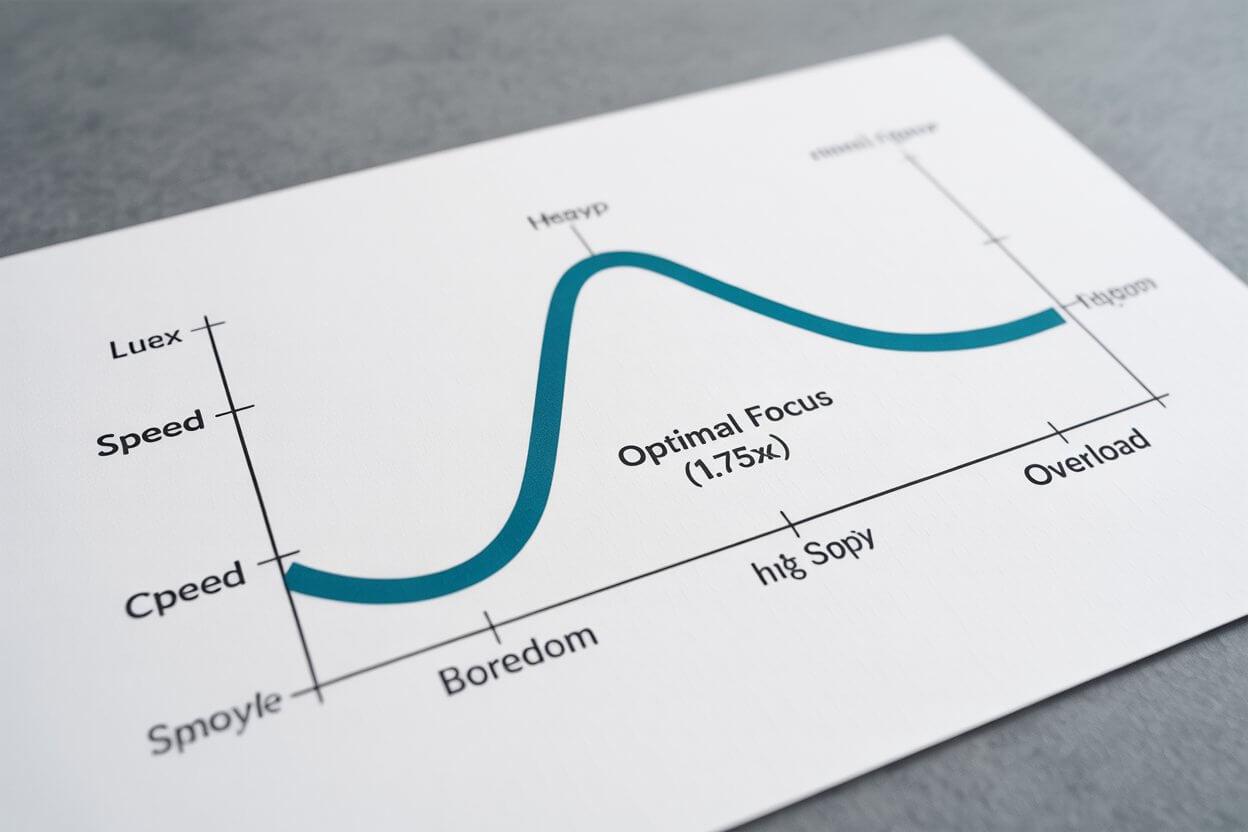
Here is how the curve works:
- Zone 1: Under-load (1.0x - 1.25x). The brain is bored. High risk of distraction. Comprehension is surprisingly low because focus is low.
- Zone 2: Optimal Flow (1.5x - 2.0x). This is the Sweet Spot. The rate of speech matches your rate of thought. You cannot think about dinner, because if you drift for 2 seconds, you lose the thread. This creates a state of forced mindfulness.
- Zone 3: Overload (2.5x+). The brain can no longer parse the phonemes (sounds) into words fast enough. Comprehension drops off a cliff.
Most people assume the limit is 1.5x. But studies suggest that with training (neuroplasticity), the average adult can comprehend speech comfortably at 275-300 wpm. That corresponds roughly to 1.8x - 2.0x speed.
The Technology: Why "Chipmunk Voice" is Dead
One reason people hate the idea of speed listening is memory.
In the early 2000s, if you sped up an MP3 file, it simply squeezed the sound waves. This raised the frequency. A deep male voice at 2x sounded like a cartoon character on helium. It was unbearable.
Modern apps do not do this.
Apps like Audible, Overcast, and Spotify now use advanced DSP (Digital Signal Processing) algorithms, specifically a technique called SOLA (Synchronized Overlap-Add).
Without getting too technical: the software cuts the audio into tiny micro-segments. It deletes a portion of the segment to save time, but it keeps the remaining waveform at the original pitch. It then stitches them back together instantly.
The result? James Clear at 1.75x doesn't sound higher-pitched. He just sounds like he had a double espresso. The emotional tone of the voice is preserved.
Retention vs. Recognition
Critics often say: "Sure, you finished the book, but do you remember it?"
This is a valid question, but it applies to reading, too. How much of the last physical book you read do you actually remember? Can you quote it? Probably not.
We need to distinguish between Retention (the ability to recall specific facts) and Synthesis (the ability to understand the main concepts).
When you speed listen to Atomic Habits, you might forget the specific name of the 1990s British Cycling coach James Clear mentions in Chapter 1. But you will remember the concept of "marginal gains."
Speed listening prioritizes Synthesis over Trivia.
I tested this on myself (small retention experiment)
Two similar-length non-fiction chapters, then a 5-question quiz on each.
| Chapter at 1x | Chapter at 2x | |
|---|---|---|
| Chapter | Ch. 4 | Ch. 5 |
| Actual listening time | 22 min | 11 min |
| Quiz score (/5) | 5/5 | 4/5 |
| How it felt | relaxed | sustained focus |
At 2x I scored one point lower but got through the chapter twice as fast. For non-fiction, that trade — a sliver of recall for half the time — is a win. It also matches the science above: comprehension holds up near 2x; it's raw trivia recall that dips first, not understanding.
How to actually Retain Information (The Protocol)
If you really want to retain information like a scholar, simply pressing "Play" isn't enough—whether at 1.0x or 2.0x. You need to move from Passive Listening to Active Listening.
Here is my 3-step protocol for high-retention speed listening.
1. The "Bookmark Blast"
Do not stop to take notes. It breaks the flow. When you hear something brilliant, hit the "Bookmark" button in your app (or take a screenshot).
Apps like Overcast allow you to export these timestamps later. Treat the audiobook like a mining operation: extract the gold nuggets (bookmarks) now, refine them (notes) later.
2. The 15-Second Rewind Rule
This is the most important button in your interface. If your mind drifts, or if a concept is complex, hit "-15s".
Do not be afraid to listen to a complex paragraph three times at 2.0x.
Do the math: Listening to a paragraph 3 times at 2.0x takes less time than listening to it once at 1.0x while distracted. And you will understand it much better.
3. The Chapter Summary (Feynman Technique)
At the end of a major chapter, pause. Take 30 seconds. Ask yourself: "What was the one thing I learned?"
Say it out loud. This forces your brain to encode the auditory signal into a long-term memory.
The Exception: When Speed IS Cheating
I want to be clear. Everything I wrote above applies to Information (Non-Fiction, News, Podcasts).
Art is different.
If you listen to a beautifully narrated novel, a poem, or a stand-up comedy special at 2.0x, you are missing the point. In art, the timing is the content. The pause is the point.
- Information: Goal is efficient data transfer. Speed is good.
- Art: Goal is emotional resonance. Speed is bad.
I listen to Atomic Habits at 2.0x. I listen to The Lord of the Rings at 1.0x. Knowing the difference is what makes you a pro.
Deep Dive FAQ: The Science of Listening
Does speed listening damage my attention span?
There is no evidence for this. In fact, many users report the opposite: because speed listening requires active, sustained focus to keep up, it trains the brain to avoid distraction. However, avoid "Doom Scrolling" on social media while listening, as that destroys attention.
Is this the same as "Speed Reading"?
No. Speed reading often involves "skimming" (skipping words or lines). Speed Listening involves compression. You still hear every single word; you just hear them faster. You are not skipping content; you are intensifying it.
What about books with heavy accents?
Cognitive load increases when processing an unfamiliar accent. I recommend dropping your speed by 0.25x when starting a book with an accent you aren't used to (e.g., a heavy Scottish accent). Once your ear attunes to the rhythm (usually after 30 mins), you can speed back up.
Conclusion: It's Not Cheating, It's Upgrading
Let's go back to that dinner party.
When someone says you "cheated" by listening fast, realize that they are viewing reading as a moral test of endurance. They think suffering through a slow book makes the knowledge more valid.
It doesn't.
Listening at 1.75x or 2.0x is simply upgrading your software to match your hardware. Your brain is a supercomputer; stop feeding it data via dial-up internet.
If you can retain the information, apply the lessons, and save 50% of your time, that's not cheating. That's winning.
See how much "Dial-Up" time you can save:
Open Speed CalculatorRelated Articles

Why I Listen at 1.75x Speed (And Why You Should Too)
Why do we listen at 1.0x when our brains process at 400wpm? The honest truth about speed listening, pitch correction, and why 1.75x might be your new normal.
The Audiobook Speed Cheat Sheet: How Long Will It Take? (Charts)
Quick reference tables for 1.25x, 1.5x, and 2.0x speeds. See exactly how much time you save on 8h, 10h, and 12h audiobooks.
Podcasts vs Audiobooks & Spotify Guide: The 3.0x Speed Strategy
Why can you listen to podcasts faster than books? We investigate the 'Information Density' theory, the Spotify 15-hour trap, and the best apps for silence skipping.